
Children have a natural urge to let off steam —sometimes in a rather rough way.
Parents often want to avoid this or steer it in the “right direction.” Boxing channels children’s—especially boys’—desire for physical confrontation and gives them the opportunity to test their strength and burn off excess energy —and that’s absolutely essential.
Boxing for kids doesn't have to have anything to do with a real boxing match. In kids' boxing, the focus is on physical activity, body control, and playful training. Many exercises are done on a punching bag or with punch pads, without any direct physical contact.
Contents:

Every punching bag tells a story—our punching bags are made with love and care in Amsterdam Handcrafted.
Relieve Frustration & Regulate Emotions
Frustration, anger, sadness— you need to let it all out. If there’s no “sparring partner” around—like a parent, sibling, or friend wearing boxing gloves—it helps to take out your frustration with a few well-aimed punches on the punching bag. A few kicks at the punching bag after school —and your head will feel clear again.
Children who practice martial arts—including children’s boxing—experience less bullying and fewer arguments. They are more often respected by their classmates. Through boxing training, they usually even become less aggressive and only use their fighting skills at the boxing club or on the punching bag.
Through boxing training, children learn to be more aware of their own bodies —how they stand, how they move, and when they need to tense up or relax. This physical self-awareness also helps them better control their emotions.
Children realize: “When I breathe calmly and concentrate, things go better.” This fosters the ability to self-regulate—an important foundation for impulse control and emotional stability.
What’s particularly interesting here is the alternation between tension and relaxation. When boxing, children don’t just have to throw powerful punches; they also have to pause repeatedly, adjust their stance, and wait for the next signal. This teaches them to use their energy deliberately, rather than just lashing out.
It’s important, however, that boxing isn’t the only strategy for dealing with anger. After a round with the punching bag, it can help to talk together about what actually upset the child so much. The physical activity can help a child become willing to listen and talk again in the first place.
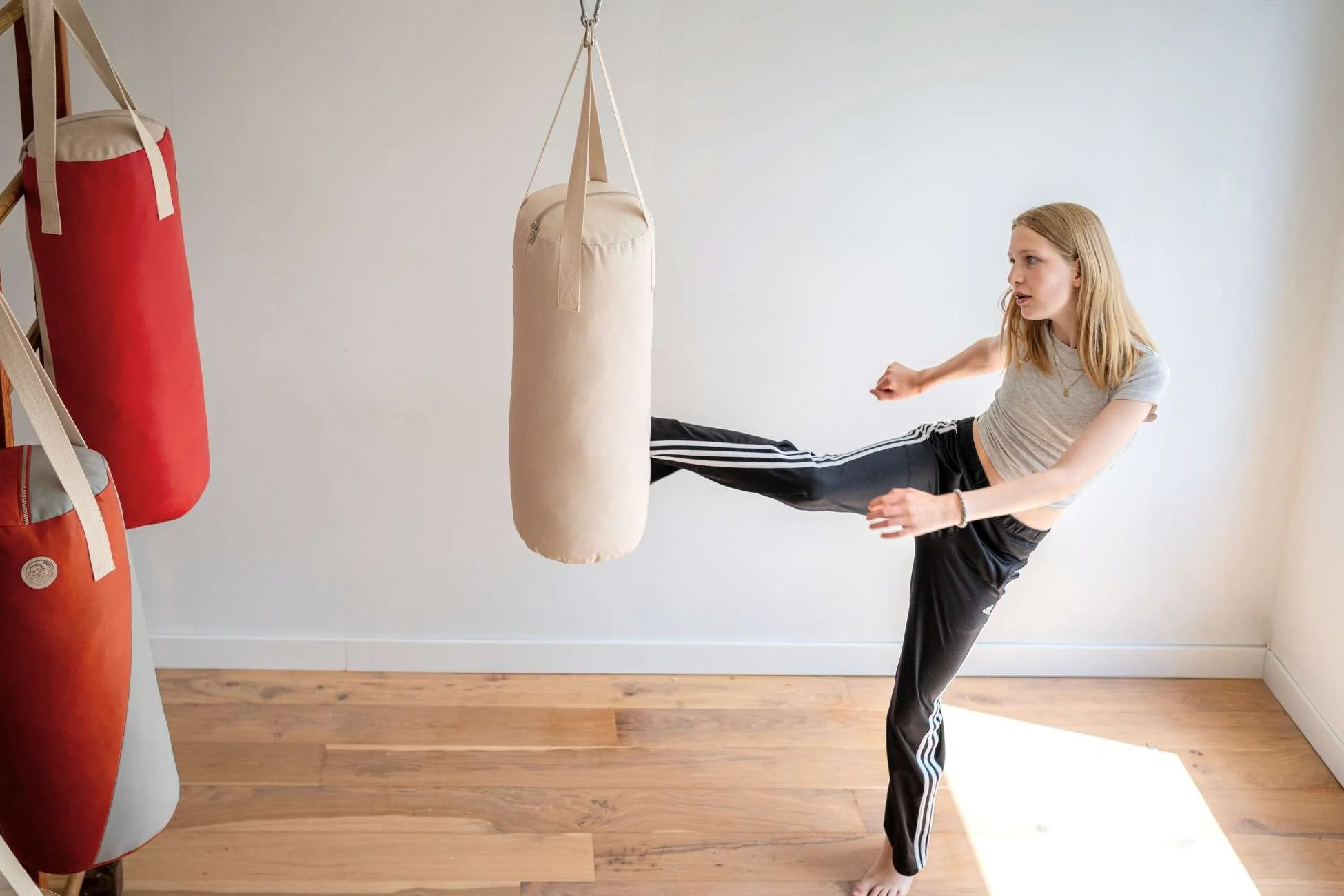
Boxing for Girls
Girls, in particular , are more likely to be raised not to fight or assert themselves physically. They often behave more reservedly. But they, too, have an urge to move and a desire for physical interaction —just like boys. It’s important that girls can express this as well, and for that, they need an outlet. An object like a punching bag (we even have pink ones ;-) or a “sparring partner” can help with this.
For example, Kristin’s 16-year-old daughter, Ireen, started boxing a year ago and says: “After practice, when you’ve really given it your all, you feel totally refreshed and just great. And when you’re in the zone, you lose track of time —when I’m really into it, I never look at the clock.”Her friends didn’t want to come to the boxing gym with her because the group there consists mainly of guys, but she thought to herself: Why not? “You also get better when you box with guys,” she says—“because they’re often a little stronger, and I learn more that way.”
What if the siblings are constantly fighting at home?
Send them to the punching bag! Boxing is a great way for (siblings) to “work out” their arguments peacefully. They can let off steam on the punching bag or box against each other—with gloves and rules. And the argument is quickly forgotten.
Especially when it comes to siblings, it’s important that all children follow the same rules. Training together on a punching bag can work better than a direct boxing match. For example, each child takes turns getting 30 seconds, while the other counts the punches or leads a short exercise.
When the kids are really angry with each other, they shouldn't be boxing each other. In moments like these, the punching bag is the better choice.
Boxes Instead of Computers
When friends come over, boxing is an active alternative to spending hours playing video games, watching TV, or staring at a smartphone. They can box together on the punching bag or spar against each other with boxing gloves, instead of just sitting “together” in front of a screen.
One particularly convenient thing is that kids don't necessarily need a training plan for this. A punching bag in the kids' room is always available. They can box for a few minutes whenever they have a spare moment and then go back to doing something else
Short exercise sessions like these are especially helpful on days when children have been sitting a lot. And unlike some team sports, you don't have to wait for enough players to show up.
What about kids who don't like to be active?
A punching bag in a child's room can be a real incentive—an easy way for kids who aren't into sports to get moving. Just a few punches or kicks—and you'll immediately feel a change in your body.
Not every child is interested in soccer, gymnastics, or joining a sports club. Some don't like team sports, while others feel uncomfortable when they have to demonstrate certain exercises in front of a group.
When boxing with your own punching bag, that pressure goes away. No one is keeping score, no one has to win, and the child can decide for themselves how long they want to train.
This easy introduction is especially appealing to children who haven't enjoyed physical activity much up to now. Instead of having to get through an entire training session right away, two or three minutes are enough to start with.
Often, the desire to exercise more develops on its own when children realize they’re getting better and better at something. It’s important not to make training a chore. After all, the punching bag should be fun—not just another homework assignment.
What are some other benefits of children's boxing?
Boxing for kids is something new— more exciting than the traditional sports that everyone plays.
It improves coordination, strength, endurance, reaction time, and concentration.
Boxing training at the boxing club consists of stretching, cardio training, exercises on the punching bag, and technique drills —either alone or with a partner. Many coaches pay special attention to leg coordination because it plays a major role in boxing.
As with any martial art, training builds self-confidence.
Children learn to use their strength in a focused and controlled manner.
It's especially the combination of different movements that makes boxing interesting. The children have to pay attention to their feet, hands, posture, and breathing all at the same time. That's not so easy at first!
For example, when a child makes a straight swing, it’s not just the arm that moves. The legs and upper body are also involved. The child must maintain its balance and return to the starting position after the swing.
At what age is children's boxing appropriate?
Boxing classes at the boxing club are available for children as young as 6. For younger children, ages 4 and up, a punching bag at home is a great way to box in a playful way. Make sure the punching bag is light enough.
More important than the child’s exact age, however, is how far along their motor development is and how much they enjoy being active. Some four-year-olds are already quite skilled at using a small punching bag, while others prefer to start with simple movement and coordination games.
Here's an overview of which punching bags are suitable for which age groups.
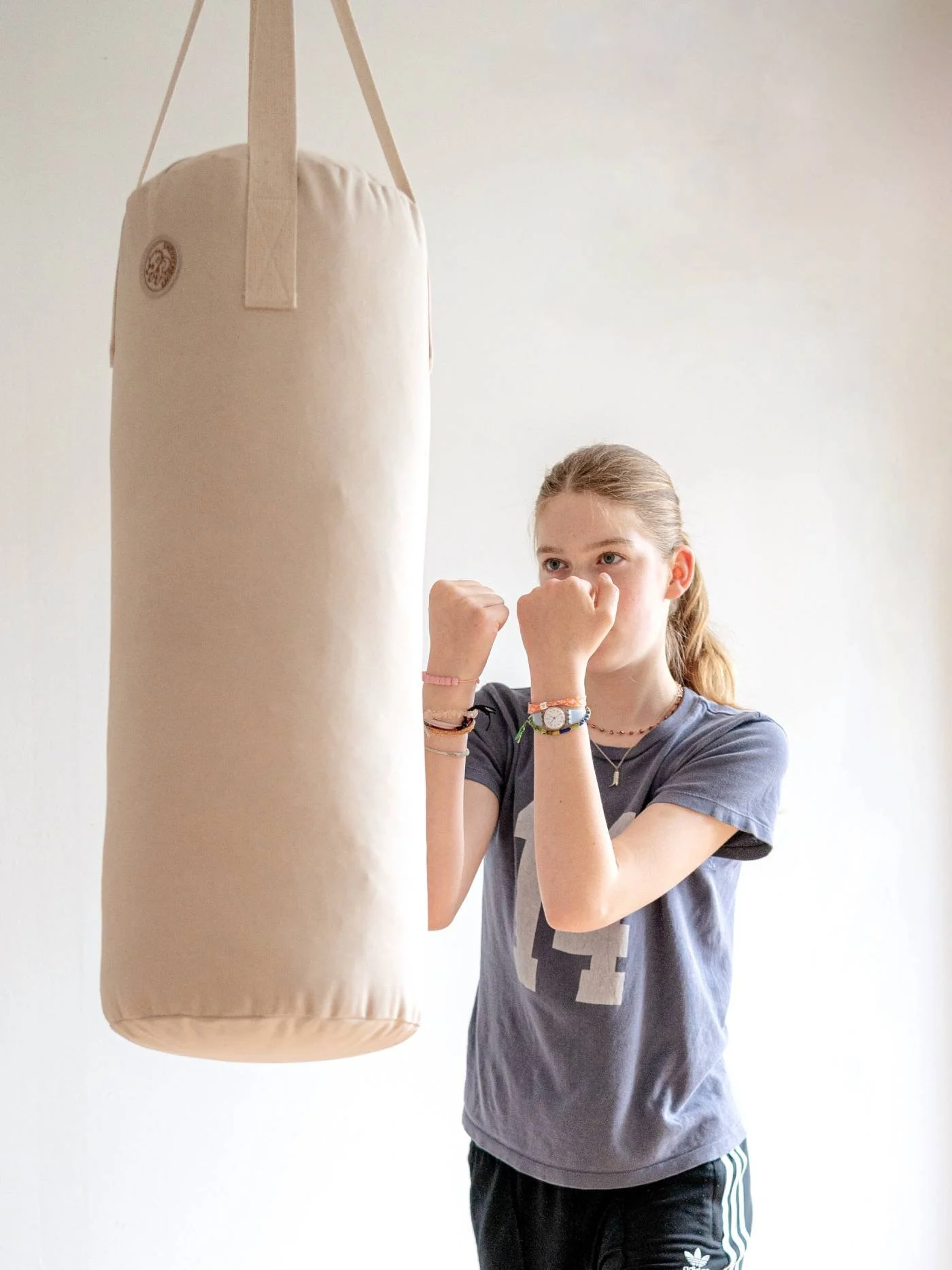
Boxing as a Form of Anti-Aggression Training
Boxing training has been a proven method for years to give children a way to burn off excess energy in a controlled manner. Families looking for an active outlet, in particular, turn to boxing. The reason is simple: When boxing, children can release their aggression on a punching bag or in a fair competition. At the same time, the training challenges the whole body and boosts self-confidence. Many children report feeling a sense of inner calm and greater balance after training.
What sets boxing apart from simply throwing punches is its set of strict rules. Training isn't about using force as uncontrollably as possible. Children must listen, follow instructions, and consciously control their movements.
For example, a coach might specify that only certain strokes are allowed or that the children must stop immediately when given a signal. These exercises, in particular, require self-control.
It’s important to distinguish between anger and violence. It’s completely normal to feel angry. Hurting other people is not. Through guided boxing training, children can learn to manage strong emotions while still following the rules.
Thera-Boxes for Children with ADHD
Boxing has also become established as a form of therapy: Special classes for children with ADHD provide a structured environment and clear rules that help improve their concentration. The discipline involved in training channels excess energy into productive activities and helps them better manage restlessness and impulsivity.
In what is known as “Thera-Boxing,” elements of boxing training are specifically used for therapeutic or educational purposes. The focus is often on motor coordination, body awareness, concentration, and the conscious management of tension.
Many exercises can be broken down into manageable steps. For example, first assume the correct stance, then practice a straight swing, and finally combine several movements.
For some children with ADHD, it can be helpful to learn a task not just by listening, but by trying it out right away. Boxing training also provides them with immediate physical feedback.
Fitness Training for Children
Boxing is a true full-body workout that strengthens many motor skills:
Coordination
Endurance
Balance
Strength and Strength Endurance
Responsiveness
If you'd like to exercise with your child at home, make sure you know the proper techniques and choose age-appropriate exercises. In the next section, we've put together a few exercises for you.
Simple boxing exercises for kids at home
You don't need much to do a little boxing workout at home. A kids' punching bag, the right gloves, and a little space are all you need to get started.
With these simple exercises, children can practice various skills:
1. Left, right—and back again
The child stands in front of the punching bag and takes turns punching with the left and right hands. The focus is not on speed, but on clean, controlled movements.
After each stroke, the hand returns to the starting position. This exercise helps develop coordination between both sides of the body.
2. Boxing on Command
Give your child simple instructions: “Left!”, “Right!”, “Stop!”, or “Twice!”.
The child must listen and perform the corresponding movement as quickly as possible. In doing so, the child not only trains their reaction time but also their concentration.
If you'd like, you can gradually make the commands a little more challenging and incorporate short combinations of strokes.
3. A race against the clock
Set a timer for 30 seconds. During this time, your child tries to keep moving with controlled strokes. Then there is a break.
Older children can gradually increase the duration. It is important that the movements are still performed correctly, even toward the end.
4. The Punching Bag as a Moving Target
Give the punching bag a gentle push and let it swing slowly. Your child will try to wait for the right moment and hit the bag with a light, controlled punch.
To do this, the child must judge distance and movement. Make sure the punching bag doesn't swing too wildly and that the child has enough space.
5. Shadow boxing in front of the mirror
You don't even need a punching bag for this exercise. The child stands in front of a mirror and practices the movements slowly in the air.
This allows him to control his posture and check whether his hands return to his sides after each swing.
This is a great way for beginners, in particular, to learn the movements before trying them out on the punching bag.
The following applies to all exercises: It’s better to train for a short time with focus than to push through for as long as possible. For younger children, just a few minutes are often more than enough. And if they lose interest, that’s it for today.
Developing Determination and Perseverance
Boxing isn't a sport where you see results overnight. Kids learn quickly: If you want to get better, you have to stick with it. Technique, stamina, and reaction time only improve with regular training.
In the process, they learn that even when things don't go as planned, it's worth sticking with it. Besides, not every child feels comfortable in team sports where winning and losing are constantly at stake.
Boxing training is less about comparing yourself to others —and more about improving yourself. Children can make progress at their own pace. Even small successes, such as mastering a new technique or building more stamina, make them feel good and motivate them to keep going. This builds their resilience —and also helps them cope better with setbacks at school, in everyday life, and later in life.
What's particularly motivating is that it's fairly easy to see progress in boxing. At first, it might be hard to land two punches in a row cleanly. After a few training sessions, the combination suddenly comes naturally.
Endurance can also be observed. A child who needs a break after 30 seconds at the beginning might be able to last a whole minute with a little practice.
Parents can support this by praising not only the result but also the effort that went into it. Saying,“You really focused while practicing today!” is often much more helpful than asking how many strokes the child managed.
How safe is children's boxing?
When parents think of boxing, they often first picture black eyes, broken noses, or hard blows to the head. However, in age-appropriate children’s boxing, none of that has to happen.
Training with a punching bag , in particular, differs significantly from traditional competitive boxing. There is no opponent to strike back. Children can practice their technique without having to take any punches.
Still, there are a few things to keep in mind.
The Right Equipment: The punching bag should be neither too heavy nor too hard. Well-fitting boxing gloves help protect your hands. However, they are no substitute for proper punching technique.
The Right Height: The punching bag should be hung so that the child can comfortably strike it at chest- to shoulder-height with bent arms. The bag should not be so high that the child has to constantly punch overhead.
A Safe Training Area: There must be enough space around the punching bag. Especially with hanging punching bags, it’s important that there is no furniture or sharp edges in the way. The mounting should be checked regularly.
Controlled Punches: Children should not try to punch the punching bag with all their strength. The correct form is more important than the force of the punch.
If you're starting out with a children's punching bag at home, you can begin by practicing the basic stance together with your child. Stand with your feet about shoulder-width apart, your knees slightly bent, and your hands in front of your body.
If you experience pain in your hands or wrists, you should stop training. When boxing with a partner, also remember: No blows to the head and no uncontrolled sparring.
Conclusion
Boxing offers children and teens an ideal way to burn off energy, relieve stress, and work on their physical and mental skills at the same time. With the right equipment and a few basic skills under their belt, boxing training becomes a valuable addition to their daily lives.
One of the best things about children’s boxing is that it appeals to a wide variety of kids. Some want to burn off their energy after a long day at school. Others enjoy learning new movements or focusing on one thing at a time in a calm environment.
It doesn't have to be regular training at a boxing club. Even a punching bag at home offers plenty of ways to incorporate exercise into daily life. The key is for children to enjoy it and learn to use their strength in a controlled way.
Want to try boxing?
We have punching bags in various sizes and colors—perfect for children and teens.
Get a punching bag for your home today. Handcrafted — durable and child-friendly—perfect for home use.
-> Here is our JUNIOR punching bag for children and teens
-> A punching bag for the whole family? Our FITNESS punching bags are perfect for that